Category: Uncategorized

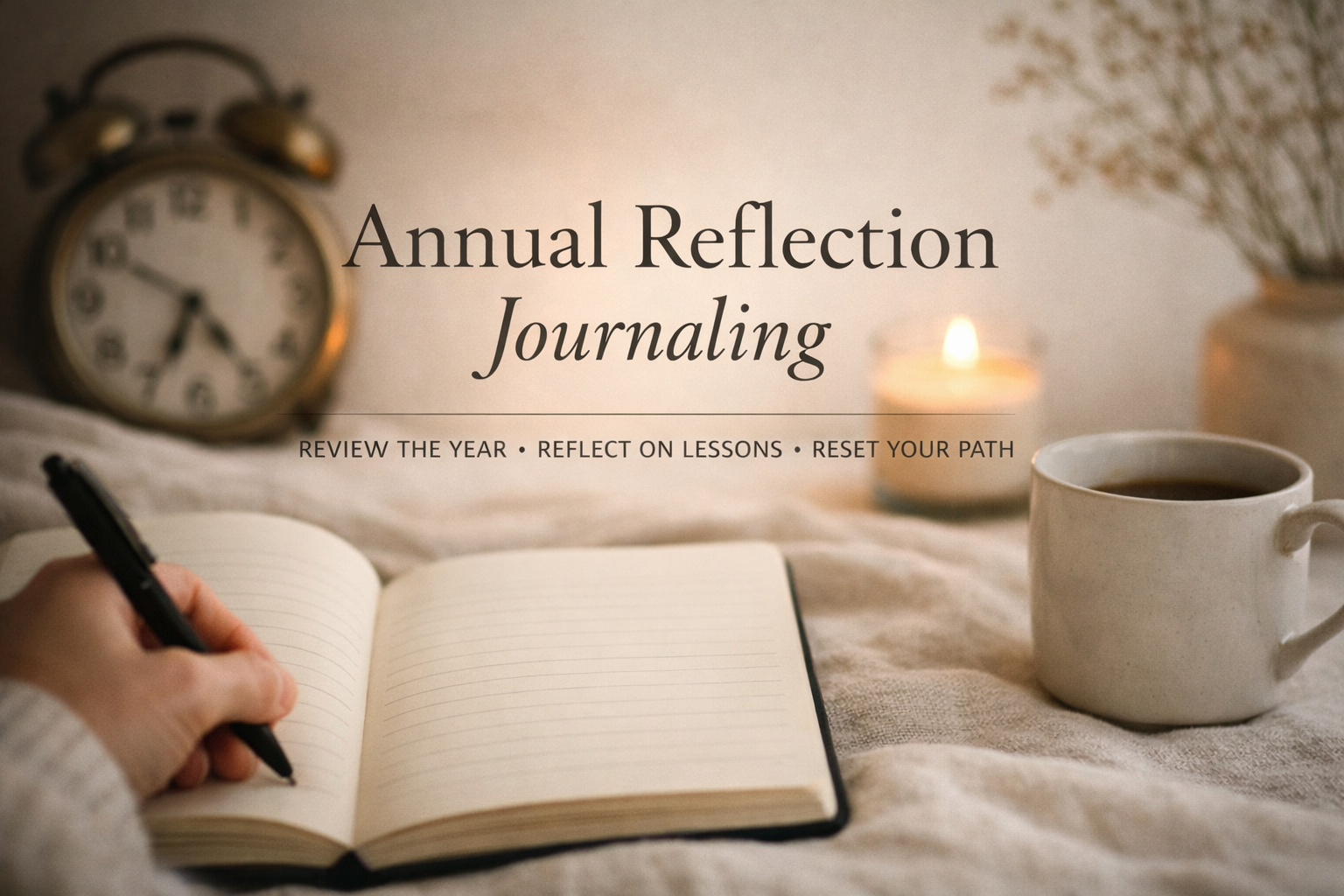
  • Annual Reflection Journaling: A Complete Guide to Taking Stock of Your Year

    Annual Reflection Journaling: A Complete Guide to Taking Stock of Your Year

    Annual reflection journaling is not about judging your year. It is about understanding it.

    At Paper Potion, this page serves as a pillar guideโ€”a long-form, evergreen resource you can return to at the end of any year to pause, reflect, and make sense of what you have lived through.

    Whether your year felt productive, heavy, quiet, or unresolved, reflective journaling offers a structured way to turn experience into clarity.

    What Is Annual Reflection Journaling?

    Annual reflection journaling is the intentional practice of reviewing a full year of your life through writing.

    Unlike daily journaling, it focuses on:

    • Patterns instead of moments
    • Meaning instead of memory
    • Integration instead of productivity

    It helps you answer one central question:

    What did this year actually shape in me?

    Why Annual Reflection Matters More Than Goal-Setting

    Many people rush from December into January with plans and pressure. Reflection asks you to slow down first.

    When you skip reflection:

    • You repeat the same emotional patterns
    • You set goals disconnected from reality
    • You overlook growth that already happened

    When you journal reflectively at year-end, goals emerge naturallyโ€”grounded in lived truth rather than expectation.

    When to Practice Yearly Reflection Journaling

    There is no โ€œperfectโ€ date. However, most people find clarity when journaling:

    • In the final weeks of December
    • During the quiet days between years
    • Early January, before setting intentions

    The key requirement is not timingโ€”it is uninterrupted attention.

    A Proven Framework for Annual Reflection Journaling

    This framework is designed to work every year. You may complete it in one sitting or across several days.

    1. Take Stock of the Year as a Whole

    Begin broadly before diving into details.

    Journal prompts:

    • How would I describe this year in one sentence?
    • What emotion defined the year most often?
    • Did this year feel expansive, constricting, or transitional?

    Do not overthink your answers. Write what surfaces first.

    2. Identify Repeating Themes

    Flip through your journal entries, notes, or memories.

    Look for:

    • Recurring worries
    • Repeated decisions
    • Patterns in energy or motivation
    • Situations that consistently drained or restored you

    Insight tip: Themes matter more than events. One repeated feeling can outweigh ten milestones.

    3. Acknowledge Quiet Growth

    Not all growth is visible.

    Reflect on:

    • Boundaries you now maintain
    • Reactions you no longer have
    • Skills you quietly strengthened
    • Emotional resilience you did not notice at the time

    This section often reveals the yearโ€™s true progress.

    4. Recognize What the Year Cost You

    Honest reflection includes costโ€”not blame.

    Write about:

    • Where your time went unintentionally
    • What demanded more energy than expected
    • Habits or commitments that no longer serve you

    Naming these costs is how future burnout is prevented.

    5. Capture the Core Lessons of the Year

    Avoid generic lessons. Focus on personal truth.

    Examples:

    • What this year taught me about rest
    • What I learned about my limits
    • What no longer feels negotiable in my life

    These insights become anchors for the year ahead.

    The Role of Journaling in Emotional Closure

    Many years remain unfinishedโ€”not because goals failed, but because emotions were never processed.

    Annual reflection journaling helps you:

    • Close open emotional loops
    • Release unresolved expectations
    • Accept what did not change

    Closure is not forgetting. It is integrating.

    How to Transition from Reflection to the New Year

    Reflection is complete when writing feels settled.

    Before moving forward, close your journaling cycle with these prompts:

    • This year asked me to slow down in order toโ€ฆ
    • I am ready to release the need toโ€ฆ
    • What I will carry forward intentionally isโ€ฆ

    Only after this step does planning become meaningful.

    Final Thought

    Not every year is meant to be impressive.
    Some years are meant to be understood.

    Annual reflection journaling gives you the language to do exactly thatโ€”one honest page at a time.

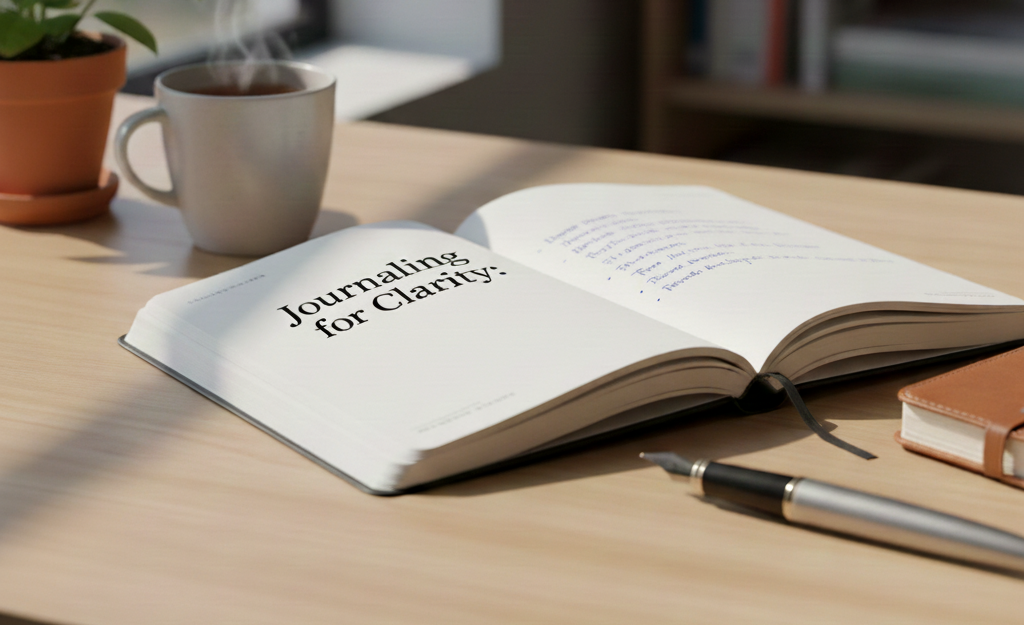
  • Journaling for Clarity: How to Turn Mental Noise into Daily Focus

    Most people assume that life feels confusing because it is complicated. In reality, everyday life feels confusing because our thoughts remain fragmented. Journaling works not by adding insight, but by reducing fragmentation. It gives scattered thoughts a place to land, organize, and stabilize. This is how journaling helps you make sense of everyday lifeโ€”not emotionally first, but structurally.

    Everyday Life Is Not Overwhelming โ€” It Is Unsorted

    Your mind processes hundreds of inputs daily:

    • Information
    • Decisions
    • Reactions
    • Expectations
    • Unfinished thoughts

    Without an external system to process them, these inputs overlap and compete for attention. Journaling functions as an external processing space, similar to how a whiteboard helps untangle complex problems.

    You are not writing to express.
    You are writing to sort.


    Journaling as a Mental Alignment Tool

    A powerful but overlooked benefit of journaling is alignmentโ€”between what you think, what you feel, and what you do.

    When you write regularly, three things happen naturally:

    1. Contradictions become visible
    2. Priorities become explicit
    3. Decisions gain context

    You begin to notice gaps:

    • Between intention and action
    • Between values and behavior
    • Between effort and outcome

    This awareness is the foundation of clarity.


    Why Writing Clarifies Thoughts Better Than Thinking

    Thinking is circular. Writing is linear.

    When thoughts stay in your head, they loop, repeat, and distort. When written down, they must:

    • Follow sequence
    • Use language
    • Make logical sense

    This constraint forces clarity. Journaling converts vague mental pressure into defined statements, which can then be evaluated, refined, or discarded.

    That alone reduces confusion.


    Journaling Turns Noise Into Signals

    Most days include both meaningful signals and irrelevant noise. Without reflection, they feel identical.

    Journaling trains you to ask:

    • What actually mattered today?
    • What drained energy without adding value?
    • What deserves attention tomorrow?

    Over time, this filtering process sharpens judgment. You stop reacting to everything and start responding only to what matters.


    A Practical Sense-Making Journaling Method (No Storytelling)

    This method avoids emotional excavation or narrative writing.

    Step 1: Dump Without Structure

    Write everything on your mind for 3โ€“5 minutes. No sentences required.

    Step 2: Group Similar Thoughts

    Circle or underline related items (work, health, relationships, decisions).

    Step 3: Identify Tension Points

    Ask: Where do I feel uncertainty, resistance, or mental load?

    Step 4: Define One Clarifying Statement

    Write one sentence that reduces confusion:

    • โ€œWhat I am actually deciding isโ€ฆโ€
    • โ€œThe real issue here isโ€ฆโ€
    • โ€œThis matters becauseโ€ฆโ€

    This process builds clarity without emotional intensity.


    How Journaling Improves Decision-Making Over Time

    Consistent journaling creates a written history of:

    • Past decisions
    • Assumptions made
    • Outcomes experienced

    This record allows you to:

    • Identify recurring mistakes
    • Spot faulty reasoning patterns
    • Build confidence in your judgment

    Life feels clearer not because problems disappear, but because you recognize them faster.


    Journaling Is a Thinking Tool, Not a Mood Tool

    Unlike approaches that frame journaling as emotional release or creative exploration, this perspective treats it as cognitive hygiene.

    Just as physical hygiene prevents illness, mental hygiene prevents:

    • Overthinking
    • Indecision
    • Emotional spillover
    • Mental fatigue
    Five focused minutes of journaling can restore clarity more effectively than hours of passive thinking.

    When Life Starts to Feel Coherent

    Over time, people who journal consistently report:

    • Less mental clutter
    • Faster decision cycles
    • Greater confidence in choices
    • Reduced emotional carryover between days

    Life begins to feel coherent, not because it slows down, but because it becomes interpretable.


    How to Begin (Without Overcommitting)

    • Write once per day
    • Use plain language
    • Avoid storytelling
    • Stop when clarity appears

    The purpose is not self-expression.
    The purpose is understanding.


    Closing Thought

    Journaling does not add meaning to life.
    It removes confusion, allowing meaning to surface naturally.

    That is how journaling helps you make sense of everyday life.